
Our understanding of the Universe is at a turning point with the predictions of the standard cosmological model and the observations from different surveys are showing tensions in several key areas. The disagreement is expressed in the value of cosmic expansion as well as in the growth of large-scale structure in the Universe. New cosmological surveys, many of which are European, may expose tension in additional areas of the concordance model. The question of cosmological tensions can be confronted in a number of ways. Firstly, survey data needs to be further analyzed for potential systematic uncertainties or biases. Secondly, there have been numerous advances in approaches to data analysis and statistics, some of which provide less dependence on cosmological models to make cosmological parameter estimates. Lastly, there are a plethora of new proposals from fundamental physics which range from novel neutrino physics to dark energy proposals (and others) which may contribute to a solution to the cosmological tensions problem. These represent the three research themes through which cosmological tensions will either be alleviated or resolved.
CosmoVerse@Bilbao 2026 (15 September – 17 September 2026 – 18 September Management Committee Meeting) is the fourth annual conference in a series of conferences that aim to establish a link between the different research areas in cosmology with the main focus on challenges of tensions in cosmological survey data.
This conference is organized within the COST Action initiative CA21136 – Addressing observational tensions in cosmology with systematics and fundamental physics (CosmoVerse).
The first conference called CosmoVerse@Lisbon 2023 took place between 30 May and 1st June 2023. All of the recorded talks and presentations are public and available here. The second conference called CosmoVerse@Krakow 2024 took place between 9 and 11 July 2024. All of the recorded talks and presentations are available here. The third conference called CosmoVerse@Istanbul 2025 took place between 24 and 26 June 2025. All of the recorded talks and presentations are available here.
The conference is organized together with IFIC (Institut de Physica Corpuscular), EHU QC at Universidad del Pais Vasco, and Basque foundation for Science.
Find the indico website with registration, abstract submission, and timetable here.
Main topics
● Observational cosmology and Systematics (cross-correlation of data, systematic effects)
● Data analysis (astrostatistics; data science in astronomy; Bayesian analysis; machine learning and artificial intelligence)
● Fundamental Physics (challenge of the cosmological hypothesis, dark energy and modified gravity, neutrino physics, dark energy, and dark matter interaction)
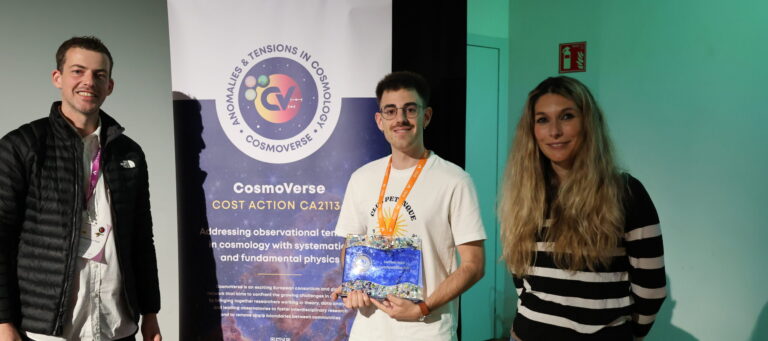
Best Posters




Invited talks
Tessa Baker
H0 (+other things) from GW Sirens
Gravitational wave (GW) events are a rapidly-developing tool for cosmology, with major applications as an independent measurement of the Hubble constant and as a probe of departures from General Relativity. I’ll explain the various `siren’ methods used to extract this information from gravitational wave detections: the bright, dark, spectral and peak siren methods. I’ll then present the most recent cosmology results from the LIGO-Virgo-KAGRA collaboration, applying the bright, dark & spectral siren methods to the latest GW event catalogue, GWTC-5. We’ll see constraints on cosmological modified gravity parameters, and the population of compact objects. I’ll introduce early results from the peak sirens method, a GW-galaxy cross-correlation technique that has different sensitivities from the dark sirens method. This signal has recently been detected in current data for the first time.
Stefano Casertano
The Distance Network: a unified analysis of local H0 measurements
The Distance Network provides a unified, statistically rigorous framework for a robust combined statistical analysis of a broad variety of local measurements of the Hubble constant. This approach provides full error propagation, accounting for commonalities between measurements, and statistical tests to identify possible outliers. We obtain an improved determination of the Hubble constant, with a baseline value of 73.50+/-0.81 km/s/Mpc, over 7 sigma from current Lambda-CDM based estimates. We test many variants that include, exclude, or modify various methods; all yield values between 72.5 and 74.0 km/s/Mpc. The algorithm and data are publically available and allow the inclusion of future measurements in this framework.
Willem Elbers
TBA
tba
Martina Gerbino
tba
tba
Valeria Pettorino
tba
tba
Jesús Torrado
tba
tba
Talks
Lilia Anguelova
tba
tba
Ozgur Akarsu
Defocusing dark energy: Raychaudhuri diagnostics beyond $w<-1/3$ and the phantom divide
In general relativity, cosmic acceleration is a statement about geometry—the timelike defocusing of the comoving congruence—and the field equations source it with mass–energy combinations, not with any equation-of-state ratio. Evolving dark energy is now back at the center of cosmology, and several scenarios under active discussion—sign-switching ΛsCDM and AdS-to-dS transitions, which simultaneously ease the H0 and S8 tensions and restore ∑mν to physical values, as well as modified-gravity backgrounds recast in GR-like form—feature an effective dark-energy density that is negative in the past and crosses zero at some redshift z†. Our standard language quietly assumes this never happens: wde<−1/3 signals repulsion only while ρde>0 and the inequality reverses on the negative branch; the phantom divide wde=−1 stops separating anything once the density changes sign; at ρde=0 the ratio wde does not exist, though nothing physical is singular there; and sign-preserving parametrizations such as w_0—w_a cannot represent the crossing at all. In this talk, based on arXiv:2607.18008, we ask what defines dark energy when w cannot, and answer with the two combinations the field equations actually use: the active gravitational mass density \mathcal{M}=\rho+3p, which drives Raychaudhuri defocusing, and the inertial mass density \mathcal{I}=\rho+p, whose zero—the null energy condition (NEC) boundary—replaces the phantom divide as the regular separator. Sharp results follow: any smooth sign switch is phantom-like and repulsive at the crossing, with the total NEC intact; the pole in w_{\rm de} is purely kinematic, with universal residue n(1+z_\dagger)/3, so w_{\rm de}=-1 is never attained and the two sides of the divide connect only through the pole; repulsion begins strictly before the switch, at z_{\rm rep}>z_\dagger; an exact window in \rho_{\rm de}'(z_\dagger) permits acceleration at the crossing itself; and the deceleration parameter admits exactly one or three sign-changing zeros. An analytic \Lambda_{\rm s}CDM profile, exponential infrared f(T) gravity, and the minimal phantom brane realize the pattern. The practical moral for reconstructions: across \rho_{\rm de}=0 the regular targets are (\rho_{\rm de},p_{\rm de},\mathcal{I}_{\rm de},\mathcal{M}_{\rm de})—kinematic totals need no dark-sector split—and parametrizations should be allowed to change sign.
Pawel Bielewicz
Constraining primordial gravitational wave amplitude and de-lensing of CMB maps – influence of Galactic foregrounds
Detecting primordial gravitational waves (PGWs) is one of the main goals for upcoming Cosmic Microwave Background (CMB) experiments. Achieving this objective requires precise removal of the CMB gravitational lensing signal from polarisation maps — so-called de-lensing — as well as cleaning the maps from diffuse Galactic foregrounds. In this talk, I will present studies on influence of the Galactic emission on the reconstruction of the CMB lensing potential and de-lensing of the divergence-free component of CMB polarization maps. Using realistic foreground models of varying complexity, we test the sensitivity of constraints on the primordial gravitational wave amplitude and the σ8 parameter to residual Galactic contamination and its interplay with de-lensing. Our results highlight that precise modelling and removal of Galactic emission will be crucial for reliably estimating the amplitude and σ8 parameter in next-generation CMB experiments.
Rebecca Briffa
tba
tba
Kishan Deka
tba
tba
Konstantinos Dialektopoulos
tba
tba
Simone D'Onofrio
tba
tba
Mina Ghodsi Yengejeh
tba
tba
Adrià Gómez-Valent
Safe Phantom Divide Crossing from Unscreened Non-Minimal Coupling to Gravity
Recent hints of dynamical dark energy, including a possible crossing of the phantom divide inferred from the latest cosmological data, have motivated the search for viable theoretical explanations. Scalar fields non-minimally coupled to gravity with a coupling of the form F(φ)=1+αφ2 are physically motivated and have emerged as promising candidates, providing a significantly improved fit to the data compared to ΛCDM and even outperforming the w0waCDM parametrization. However, in the absence of a screening mechanism, the regions of parameter space examined exhaustively so far in the literature (with α<0) violate stringent local constraints on the strength and time variation of gravity and enhance the amplitude of matter fluctuations at low redshifts and cosmological scales, in tension with galaxy clustering and weak-lensing observations, thereby compromising the actual viability of these solutions. In this work, we investigate a largely unexplored region of parameter space (with α>0) that realizes a crossing of the phantom divide while remaining consistent with Cassini–Huygens bounds and the most recent (and tightest) Lunar Laser Ranging measurements, without introducing higher-derivative terms in the action. This setup, which admittedly is subject to some degree of fine-tuning, fully respects the BBN constraints and leads only to mildly larger values of the effective gravitational coupling in the past, peaking at the onset of dark energy domination at approximately 0.5\% above Newton’s constant. We review the background and linear perturbation dynamics of the model, deriving illustrative analytical results that provide physical insight into its behavior, and update the constraints on the model using the latest cosmological data, including the DES-Dovekie supernova sample. We perform for the first time a full-fledged Monte Carlo analysis with α>0, studying also the impact of the variation of G on the supernovae likelihood, and compare the results obtained with α<0.
Eduardo Guendelman
tba
tba
Surajit Kalita
tba
tba
Nihan Katirci
tba
tba
Krzysztof Lisiecki
tba
tba
Mali Land-Strykowski
tba
tba
Archan S. Majumdar
tba
tba
Upala Mukhopadhyay
tba
tba
Oliver Oayda
tba
tba
Davide Pedrotti
tba
tba
Leandros Perivolaropoulos
Addressing the DESI DR2 Phantom-Crossing Anomaly and Enhanced $H_0$ Tension with Reconstructed Scalar-Tensor Gravity
Recent cosmological data, including DESI DR2, highlight significant tensions within the ΛCDM paradigm. When analyzed in the context of General Relativity (GR), the latest DESI data favor a dynamical dark energy (DDE) equation of state, w(z), that crosses the phantom divide line w=−1. However, this framework prefers a lower Hubble constant, H0, than Planck 2018, thereby worsening the tension with local measurements. This phantom crossing is a key feature that cannot be achieved by minimally coupled scalar fields (quintessence) within GR. This suggests the need for a new degree of freedom that can simultaneously: (A) increase the best-fit value of H0 in the context of the DESI DR2 data, and (B) allow the crossing of the w=−1 line within a new theoretical approach. In this talk I will demonstrate that both of these goals may be achieved in the context of Modified Gravity (MG), and in particular, Scalar-Tensor (ST) theories, where phantom crossing is a natural and viable feature.
Marco Regis
tba
tba
Guido Risaliti
tba
tba
Massimiliano Romanello
tba
tba
Pilar Ruiz-Lapuente
tba
tba
Vincenzo Salzano
tba
tba
Tiziano Schiavone
tba
tba
Elliot Scott
tba
tba
Chandra Shekar Saraf
tba
tba
Denitsa Staicova
Reconstructing the Type Ia Supernova Absolute Magnitude with Two-Probe Physics-Informed Neural Networkstba
We apply two variants of Physics-Informed Neural Networks (PINNs) to reconstruct the Type Ia supernova absolute magnitude M_B(z) from joint BAO and supernova data under four cosmological models (\LambdaCDM, CPL, GEDE, \Lambda_sCDM) and two DESI DR2 fiducial sets. A heteroscedastic single-network method tested across four constraint configurations establishes that the Etherington distance duality relation is more fundamental constraint than cosmological model priors, with DDR violations of 30–52 mmag under physical constraints versus 85–2330 mmag without. Under full constraints all models recover M_B \approx -19.3 mag with biases below 0.05 mag. A Fisher information-weighted two-network variant trains independent networks on BAO and SN data, providing clean probe separation and finding no significant M_B evolution in z \in [0.3, 1.5]. The heteroscedastic method identifies a persistent 2-3\sigma residual at z \sim 0.4-0.5 that is consistent across all four models and both fiducials; the Fisher method finds no significant pointwise deviation in z\in[0.3,1.5] but shows a systematic separation of redshift-binned M_B distributions consistent with the same underlying tension. While the origin of this feature remains ambiguous, its model-independence and cross-method consistency warrant further investigation with forthcoming data.
Yo Toda
tba
tba
David Wiltshire
tba
tba
Jess Worsley
tba
tba
Venue
The conference took place at the Bilbao Aretoa. The talk will be at the Mitxelena auditorium and the posters will be exhibited at the Chillida and Axular rooms.
Local organizing committee
Mariam Bouhmadi López (Ikerbasque and EHU, Bilbao)
Ruth Lazkoz Sáez (EHU, Bilbao)
Asier Alonso Bardaji (EHU, Bilbao)
Tom Broadhurst (Ikerbasque and EHU, Bilbao)
Iván Esteban Muñoz (EHU, Bilbao)
Sara Fernández Uria (EHU, Bilbao)
Joanes Lizárraga Olano (EHU, Bilbao)
Asier López Eiguren (EHU, Bilbao)
Gonzalo Olmo (UV, Valencia)
Kepa Sousa Sánchez (EHU, Bilbao)
Jon Urrestilla Urizabal (EHU, Bilbao)
Ismael Ayuso Marazuela (EHU, Bilbao)
David Figueruelo Hernan (EHU, Bilbao and University of Oslo)
Mikel Artola Pérez (EHU, Bilbao)
Julen Estonba Loinaz (EHU, Bilbao)
Carlos García Boiza (EHU, Bilbao)
Beñat Ibarra Uriondo (EHU, Bilbao)
Carmelo López Mediavilla (EHU, Bilbao)
Paloma Morilla Martínez (EHU, Bilbao)
Javier Ortega del Río (EHU, Bilbao)
Johanna Stammer Goldaracena (EHU, Bilbao)
Scientific organizing committee
Jackson Levi Said (University of Malta, MT)
Eleonora Di Valentino (Sheffield University, UK)
Noemi Frusciante (UNINA, IT)
Agnieszka Pollo (National Center for Nuclear Research & Astronomical Observatory of the Jagiellonian University, PL)
Marika Asgari (Newcastle University, UK)