What is your name, affiliation, academic position, and job title?
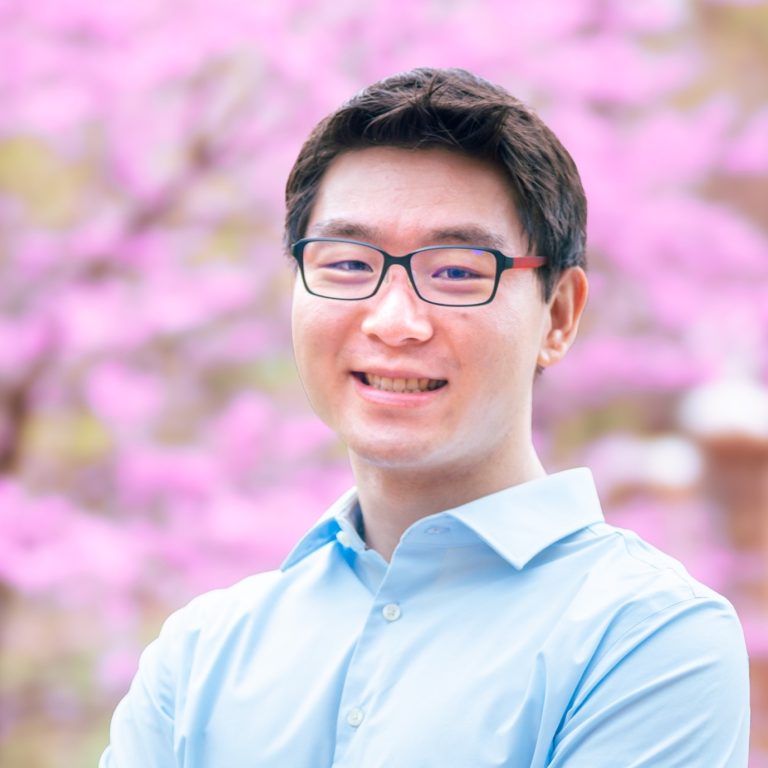
My name is Siyang (Sean) Li, and I’m currently a 5th year PhD student and National Science Foundation Graduate Research Fellow at Johns Hopkins University.
What is your field of research and/or what project are you involved in?
I currently characterize, scrutinize, and refine astrophysical tools called standard candles, which are used to measure distances to galaxies and determine the present expansion rate of our universe, the Hubble constant (H₀). The motivation for my work lies in investigating the origins of the Hubble Tension—a discrepancy between two approaches to measuring H₀ that hints at either significantly underestimated uncertainties in these measurements or new physics we are not yet aware of. My recent work has involved using the James Webb Space Telescope to analyse observations of two standard candles: the Tip of the Red Giant Branch (TRGB) and J-region Asymptotic Giant Branch (JAGB). I use these observations to perform extensive checks on the robustness of both methods and another standard candle called Cepheids, as well as to provide an independent avenue to measure H₀.
Briefly describe your career trajectory to date. What positions have you held, when and where?
My journey into astrophysics began during undergrad at the University of California, Berkeley, where I developed a foundation in instrumentation. There, I was mentored by Dr. George Smoot and worked on characterizing silicon photomultipliers, a type of photodetector with single-photon and high timing resolution, in an effort to build a telescope that could detect sub-millisecond transients in the optical wavelengths. Much of the project was carried out at labs around the world, which led me to travel during my summer and winter breaks and conduct research at the Hong Kong University of Science and Technology, with additional trips to the Paris Centre for Cosmological Physics in France and the Energetic Cosmos Laboratory at Nazarbayev University in Kazakhstan. I also spent a summer working with Drs. Shelley Wright and Jérôme Maire characterizing a near-infrared discrete avalanche photodiode array for the Panoramic All-sky All-time Near Infrared and Optical Search for Extraterrestrial Intelligence project at the University of California, San Diego. The experiences I had during undergrad were invaluable and played an instrumental role in my development as a scientist. When applying to graduate schools, I wanted to return to what had initially sparked my interest in astronomy — cosmology — and at the time, I felt that the best way to delve into this was through more observational work. So, after completing my degree at Berkeley, I headed to Johns Hopkins to work with Dr. Adam Riess on investigating the Hubble Tension. I will be heading back to the University of California, Berkeley this fall as a Brinson Prize Postdoctoral Fellow to work with Dr. Alex Filippenko and continue my work in cosmology.
What are your research plans?
My research plans are to continue scrutinizing and refining population-based standard candles, primarily the TRGB and JAGB. In particular, with the JAGB being relatively new, I believe there are many aspects of this candle and method that we still do not fully understand—areas that can be probed in a multitude of ways. This could lead to exciting new opportunities and research projects, all with the goal of either better refining this candle or improving our understanding of its limitations.
How does CosmoVerse fit within those plans?
CosmoVerse provides an excellent opportunity to network and communicate results from my area of research, bringing together researchers from around the world to discuss pressing cosmological questions such as the Hubble Tension. I believe one of the best ways to investigate this tension is through a community effort, and CosmoVerse — with its well-organized workshops, conferences, and talk series — offers a unique platform to support that effort.
What are the most exciting open questions in your research area?
In my own line of research, I believe there is still much we don’t understand about the JAGB. For instance, how far can we feasibly reach in distance with the JAGB? What causes JAGB measurements to vary across different regions of a galaxy? While several groups have already done excellent work investigating this standard candle, there remains significant potential for further study in this area.
What advances or new results are you excited about or looking forward to?
I’m currently most excited about other, independent ways to measure and probe H₀, as well as the Lambda Cold Dark Matter (ΛCDM) model, that can increase our leverage and provide deeper insights into resolving the Hubble Tension. For instance, there are alternative methods of measuring H₀ using techniques I do not currently employ, such as surface brightness fluctuations, as well as further analysis and confirmation of results from the Dark Energy Spectroscopic Instrument (DESI), which may provide additional evidence that the ΛCDM model assumed when measuring H₀ could require revision.
What is your view on cosmic tensions? How does your work connect with this open question in the community?
I believe the cosmic tensions we are seeing today can be interpreted as a natural progression of science in the Kuhnian sense. While there is certainly still much work to be done, it’s also this very tension that makes the field especially exciting right now. My work seeks to directly probe the Hubble Tension by providing analysis and data to help the community better understand its origins.
What role do you think a community network like CosmoVerse can play in developing theoretical astroparticle physics and cosmology?
CosmoVerse does a great job not only of bringing researchers together, but also of developing the next generation of scientists in the field through events such as workshops, talk opportunities, and summer schools. The sustainability of the field depends in part on training younger researchers, and CosmoVerse provides ample opportunities for early-career astroparticle and cosmology researchers to grow professionally.